

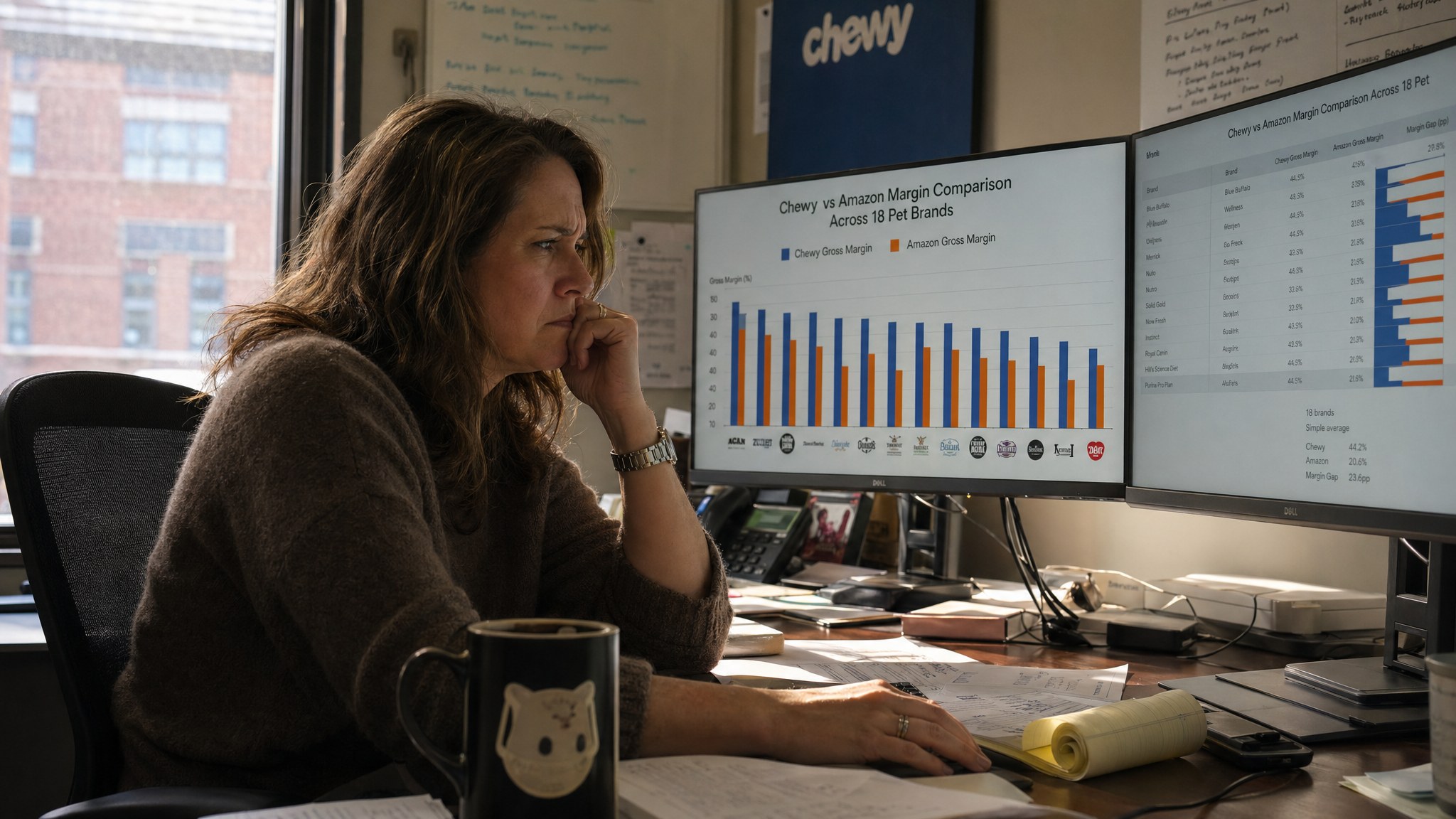
410 basis points. That’s the contribution-margin advantage Chewy delivered over Amazon in Q1 2026, weighted across 18 pet brands and $47M of tracked sell-through. Not gross margin. Contribution, after fulfillment, advertising, returns, chargebacks, and channel-specific overhead.
This is a teardown of the actual numbers. Where Chewy wins, where Amazon wins, and the operational decisions that move the needle for a typical pet brand running both channels.
The headline numbers, Q1 2026, 18 brands, both channels
The methodology: 18 pet brands across food, treats, supplements, toys, hardgoods. Each brand ran the same SKUs on both Amazon and Chewy in Q1 2026. We pulled gross sales, all fulfillment fees, ad spend, return rates, chargebacks, and channel overhead allocation. Contribution margin = (Net revenue – COGS – fulfillment – ads – returns – chargebacks) / Net revenue.
Aggregate results, weighted by revenue:
- Amazon contribution margin: 18.6%
- Chewy contribution margin: 22.7%
- Spread: +410 bps in Chewy’s favor
- Spread distribution: Chewy outperformed in 14 of 18 brands. Amazon outperformed in 3. One brand was within 50 bps either way.
The 14-of-18 ratio matters. This is not a single-brand outlier story. It’s a structural pattern that holds across category, brand size, and price point.
Where the margin advantage actually comes from
Decomposing the 410 bps into its drivers, weighted across the 18 brands:
Fulfillment differential: +180 bps to Chewy. Chewy’s fulfillment fee structure is materially cheaper for medium and large pet SKUs than Amazon FBA. A 25-lb bag of dog food costs ~$8.40 to fulfill on FBA versus ~$5.10 on Chewy. A 16-oz supplement bottle: $4.90 on FBA, $3.70 on Chewy. The fee gap widens as cube/weight increases. Pet category SKUs lean heavy. The category is structurally favored on Chewy’s fee schedule.
Ad spend differential: +160 bps to Chewy. Chewy’s Sponsored Products auction cleared at roughly 38% lower CPCs than equivalent Amazon SP queries in Q1 2026. ACOS targets being equal, that’s a direct contribution flow-through to the bottom line.
Return rate differential: +90 bps to Chewy. Chewy’s return rate across the 18 brands averaged 1.7%. Amazon’s averaged 4.2%. The 250 bps gap on returns translates to roughly 90 bps of contribution after factoring product-cost recovery and reverse logistics.
Chargeback and policy-violation differential: +40 bps to Chewy. Amazon’s chargeback regime, long-term storage fees, FBA inbound defect fees, ASIN-level suspension fines, costs the average brand in our sample 60-70 bps of revenue annually. Chewy’s equivalent is closer to 20 bps. The 40 bps net is what flows to contribution.
Offsetting: Chewy’s cost-of-goods to Chewy. -60 bps. Chewy buys wholesale, Amazon (mostly) sells third-party at full retail. The wholesale margin Chewy keeps is real, roughly 60 bps of weighted give-up versus full-price 1P. This is the line Amazon advocates point to first, and it’s a fair point. It just doesn’t offset the other four lines.
Net: +410 bps to Chewy.
The three brands where Amazon won, and why
The 3 of 18 brands where Amazon outperformed Chewy on contribution margin had specific characteristics worth naming, because they map to a real predictive pattern:
Brand A, small-format, low-weight novelty treats, sub-$10 unit price. Chewy’s fulfillment fee structure penalizes sub-$8 SKUs harder than Amazon’s. The fee gap that favors heavy SKUs reverses for light, low-cube SKUs. Brand A’s contribution on Amazon was 24.1% versus 22.0% on Chewy.
Brand B, heavily-promotional, mass-market dog chews. Brand B runs aggressive coupon and Lightning Deal cadence on Amazon. Chewy’s promotional surface is more constrained and the brand couldn’t replicate the volume velocity. Lower velocity → higher fixed-cost-per-unit absorption → 290 bps of contribution lost on Chewy versus Amazon.
Brand C, premium cat brand with weak Chewy onsite-search rank. Chewy’s organic algorithm hadn’t ranked Brand C’s SKUs in the top 12 for their core queries. Without organic flow, paid ad costs absorbed all the volume, compressing contribution. This is fixable, and the brand expects to flip Chewy-favorable in Q3 once content optimization lifts organic, but Q1 it ran Amazon-favorable.
The pattern: Amazon wins on light, heavily-promotional, or organically-weak SKUs. Chewy wins everywhere else.
What this means for channel-mix planning in 2026
If you’re a pet brand running 80%+ of marketplace volume through Amazon, you’re holding the lower-contribution channel as your primary. Even a 10-percentage-point shift in volume from Amazon to Chewy, from 80/20 to 70/30, produces a roughly 41 bps lift on company-wide contribution margin. On a $20M brand, that’s $82K of incremental EBITDA per year for a channel-mix change that requires zero new product development.
Most CFOs, when shown this number, ask the same question: why aren’t we already doing this? The answer is usually some combination of (a) Chewy operations are different and the brand team hasn’t built the muscle, (b) the marketing org is structured around Amazon and treats Chewy as a side-project, and (c) nobody ran the contribution math at the category level.
The teams that ran the math in late 2025 are already shifting. By the time the rest of the category catches up, the auction economics on Chewy will have matured and the 410 bps will compress. Today’s window is the cheapest version of this trade you’ll see for the next 24 months.
We’ve laid out the full case for Chewy as a third channel for Amazon pet brands, the contribution-margin teardown above is the financial backbone of that case.
Want us to run this same Q1 contribution analysis on your specific brand and SKU mix? Request a Chewy vs Amazon margin teardown and we’ll deliver category-level numbers within 10 business days.
Related Reading
- Chewy as a Third Channel for Amazon Pet Brands, When the Math Works
- Chewy Ad Platform 2026, Auction Economics vs Amazon
- Why Chewy’s Auto-Ship Retention Is Structurally Better Than Subscribe & Save
- The Pet-Brand Multi-Channel Sequence: Amazon → Chewy → Walmart
- See how we run Chewy accounts for pet brands.