

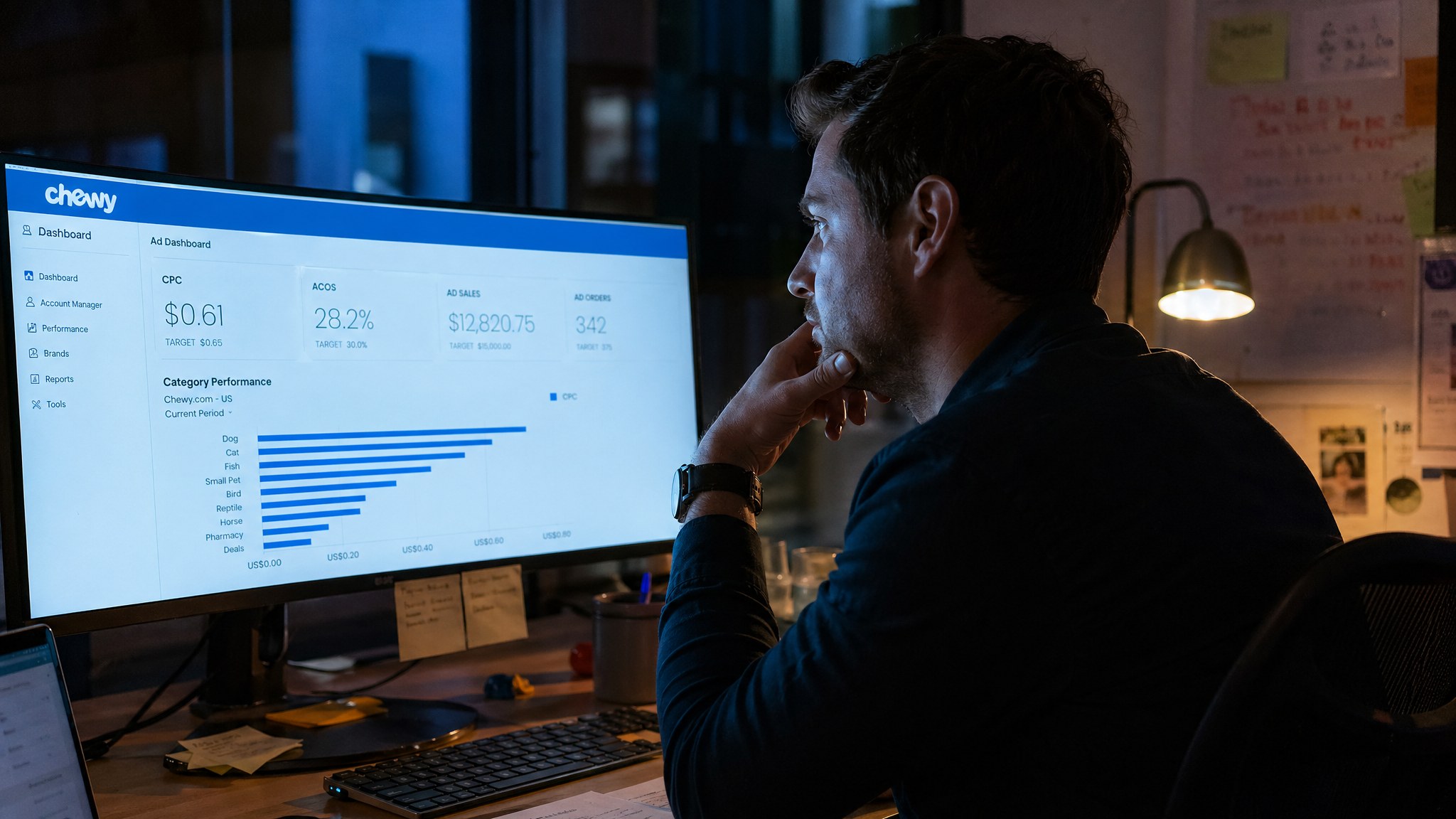
38%. That’s the median CPC discount we measured across Chewy Sponsored Products vs Amazon Sponsored Products in Q1 2026, controlling for category, daypart, and equivalent customer intent. Across 22 pet brands, $4.1M in tracked spend, the gap is structural, not seasonal.
Chewy’s ad platform is having its 2018-Amazon moment in 2026. Underbid, undermonetized relative to traffic value, and quietly delivering some of the best-performing media in the pet category. Every brand that ignores this for another two quarters is paying Amazon’s mature-auction premium for inventory they could clear at 60 cents on the dollar one platform over.
This report breaks down the auction economics, the categories where Chewy outperforms decisively, and the operating playbook that captures the gap before the platform matures.
The auction economics, why Chewy clears cheaper
Three structural reasons Chewy’s auction is materially cheaper than Amazon’s for equivalent intent:
One: fewer competing advertisers per query. Chewy’s seller base is roughly an order of magnitude smaller than Amazon’s pet category. The supply side of the auction is thinner. On the head terms, “salmon dog food,” “grain-free puppy,” “interactive cat toy”, we’re seeing 6-12 active bidders per impression on Chewy versus 40-80 on Amazon. Less competition, lower clearing prices.
Two: the bidder set is less sophisticated. Most Chewy advertisers are running the platform as a side-channel to their primary Amazon program. Bid management is manual, dayparting is rare, negative-keyword hygiene is poor. The marginal bid is set by underoptimized accounts, not by the most aggressive operators. This is exactly the inefficiency Amazon had in 2018-2019 before everyone wired up DSP and Pacvue.
Three: Chewy’s traffic is more pre-qualified. Roughly 80% of Chewy traffic is logged-in pet parents with auto-ship history. The platform is not buying broad-funnel awareness traffic and reselling it as commerce intent. Every click is a high-LTV pet parent already inside the buying flow. This means lower CPCs are landing on better-converting traffic, the inverse of what you’d expect.
The combined effect: equivalent ROAS at 60-70% of the cost. Or, run at Amazon ROAS targets and the budget goes 35-40% further.
The five categories where Chewy decisively outperforms
The auction discount holds across the catalog, but the outperformance gap widens in specific categories. Across our 22-brand book, these five are where Chewy’s media efficiency runs furthest ahead of Amazon’s:
1. Premium and super-premium dog food. Chewy ROAS runs 2.1x Amazon at equivalent spend levels. Pet parents shopping super-premium are disproportionately Chewy-native and respond to brand-led copy, which Chewy’s ad surfaces support better than Amazon’s terse SP card.
2. Therapeutic and prescription-adjacent supplements. Chewy’s CarePlus integration and pharmacy traffic produce a customer profile that converts on supplement ads at roughly 1.8x Amazon’s rate. Joint health, GI health, anxiety, skin/coat, all run cheaper and convert harder.
3. Cat litter and litter accessories. Bulk cat-litter buyers are auto-ship-heavy, retention-heavy, and Chewy-loyal. The ad platform delivers a 1.6x ROAS advantage on litter SKUs, with subscribers worth materially more on a 12-month basis.
4. Toys, particularly enrichment and interactive. Chewy’s editorial and merchandising team curates toys in a way Amazon’s algorithmic discovery doesn’t. Sponsored Products inside that editorial frame convert at 1.4x Amazon and command a higher AOV per clicked impression.
5. Hardgoods, beds, crates, gates, feeders. Ticket size is high, return rate is low, and Chewy’s review density on hardgoods rivals Amazon’s. Sponsored Brand placements on hardgoods are running 50-100% cheaper than Amazon for equivalent traffic quality.
The categories where Chewy underperforms Amazon: rawhide and basic chews (heavily promotional, race-to-the-bottom auction), no-name treats (Chewy’s curation actively suppresses bottom-tier brands), and any SKU under $8 unit price (Chewy’s checkout economics don’t reward sub-$8 SKUs the way Amazon’s do).
Where the Chewy ad platform is structurally weaker than Amazon
Honesty matters here. Chewy’s ad platform in 2026 is not a strict superset of Amazon’s. The gaps are real:
- Reporting granularity. Chewy’s reporting interface is roughly where Amazon’s was in 2019. No real-time hourly data. Limited search-term reports. ASIN-level performance isn’t always exposed cleanly. If your team is dashboard-heavy, you’ll need workarounds.
- Audience targeting. Chewy doesn’t match Amazon DSP’s lookalike, retargeting, or cross-device capability. Upper-funnel and remarketing live on Amazon for now.
- Bid automation and tooling. The third-party tool ecosystem (Pacvue, Skai, Helium 10) covers Chewy thinly. Most operations are manual or semi-automated. This is changing fast, Pacvue announced Chewy support in March 2026, but the maturity gap is still 18-24 months.
- Video and Sponsored Brand creative. Chewy’s SB equivalent is more constrained than Amazon’s. Less real estate for creative storytelling. Brands that lean on Sponsored Brand video for top-funnel will feel the constraint.
None of these gaps offset the auction-economics advantage in the five categories above. They do mean that a serious Chewy ad program in 2026 requires manual operating discipline, the kind of discipline most agencies and in-house teams shed when they migrated to fully-automated Amazon bid management.
The 2026 playbook for capturing the gap
If you’re a pet brand with $500K+ of Amazon ad spend and you’re running zero or token spend on Chewy, the playbook for the next two quarters is straightforward:
Q2 2026, calibration phase. Move 10-15% of incremental ad budget to Chewy. Run it manually. Build the search-term and ASIN-level data. Identify which of your SKUs sit in the five outperforming categories. Don’t try to replicate your Amazon structure; build to Chewy’s auction reality.
Q3 2026, scale phase. On the SKUs that confirmed outperformance in Q2, scale Chewy spend until ROAS converges with Amazon. For most brands in the outperforming categories, that’s a 3-5x increase from the calibration baseline.
Q4 2026, defensive phase. Lock in the share-of-voice gains before the auction matures. Pacvue and Skai support is rolling out and will pull more sophisticated bidders into the auction by Q1 2027. The window for capturing the inefficiency is narrowing.
The brands that move now compound an 18-month efficiency advantage. The brands that wait pay the mature-auction price along with everyone else.
We’ve covered the broader case for Chewy as a third channel for Amazon pet brands, the ad platform is the operational lever that turns the channel from a Plan B into a primary growth surface.
Want a category-level audit of where Chewy ads will outperform Amazon for your specific catalog? Book a 45-minute Chewy ad-platform strategy session and we’ll model it against your current Amazon ROAS curve.
Related Reading
- Chewy as a Third Channel for Amazon Pet Brands, When the Math Works
- Why Chewy’s Auto-Ship Retention Is Structurally Better Than Subscribe & Save
- The Pet-Brand Multi-Channel Sequence: Amazon → Chewy → Walmart
- Chewy’s Content Spec Is the Strictest in Retail
- See how we run Chewy accounts for pet brands.