

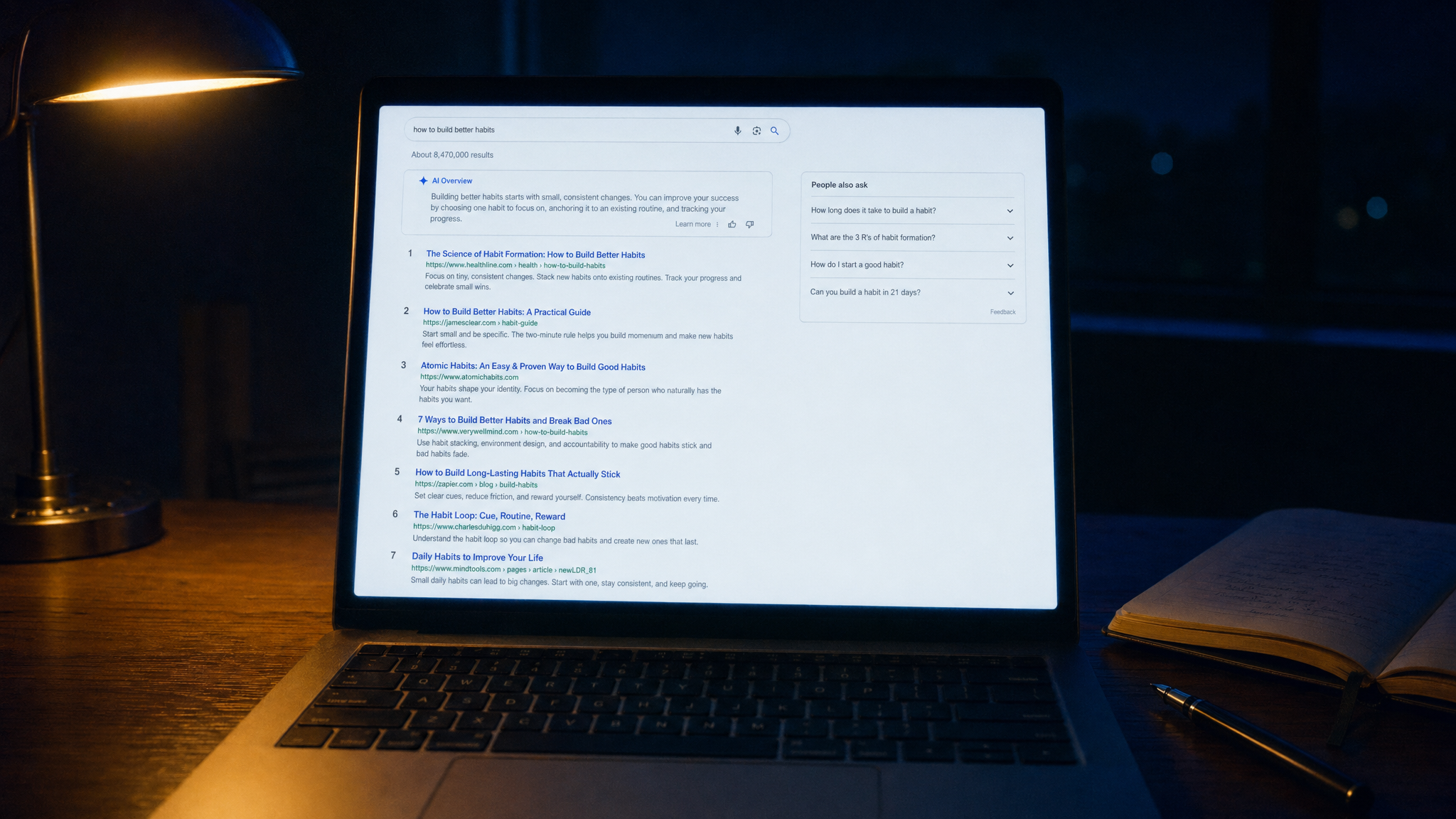
We’ve been pulling AI Overview citations across 60 product queries in our managed categories for the last six weeks. The pattern is consistent and counterintuitive: when Google’s AI Overview answers a “best [product]” query, it almost never cites the Amazon listing.
It cites review aggregators, Wirecutter, NYT, RTINGS, Reviewed, plus a long tail of category-specific sites. Sometimes Reddit. Sometimes the brand’s own /resources or /blog page. Almost never the product detail page on amazon.com.
Specifically, across the 60 queries, the citation distribution we logged looked like this: aggregator review sites got 64% of citations; category-specific publications and forums (RTINGS, Tom’s Hardware, the larger product subreddits) 21%; brand-owned content (the brand’s own blog or knowledge base) 9%; Amazon product detail pages 4%; everything else 2%. The Amazon listing isn’t getting outranked, it isn’t getting indexed for these queries at all on the AI surface.
That’s the opposite of what most brands assume. The thinking goes: “We rank #1 organically on Amazon for the term. AI Overviews must be sourcing from us.” They’re not. They’re sourcing from the third-party content that describes you. The detail page is your conversion surface, not your discovery surface, and on Google’s AI side, your discovery surface is everywhere except amazon.com.
The implication isn’t that you should ignore your Amazon listing, that page is doing other work, and Rufus is rewriting queries on the listing’s own surface (which is exactly why a Cosmo-aware A+ rebuild matters even on the Amazon side). The implication is that your brand’s Google-side visibility in the SGE era is downstream of who’s talking about you off-Amazon, and most Amazon-only brands have a flat-zero footprint there. That’s the same gap that makes a catalog-as-product mindset essential: your brand’s visible surface is much bigger than the detail page.
The move isn’t to stuff your detail page with schema and hope. It’s to seed credible, citable third-party coverage of your category-anchor SKUs and make sure the language matches the queries you care about. That work has three pieces: identify the 5-10 publications and creators in your category whose content gets cited (most operators don’t actually know this, pull it from a 30-query AI-Overview audit and you’ll have your map in an afternoon), build relationships with the 2-3 of them with the highest citation share, and write the language they need to be able to cite you cleanly.
That’s a separate workstream. It doesn’t live in your Amazon agency’s SOW. It probably should.
Subscribe to the Operator Brief, we publish AI-search visibility updates monthly.
Related Reading
- AI Overview Citation Share in 2026, What 600 Product Queries Told Us
- How to Identify the 5-10 Publications Citing Your Category in AI Overviews
- Schema Markup for Ecommerce Brands in the SGE Era, What Changed
- Why Your Amazon Brand Needs a Google Footprint in 2026
- See our Amazon management and insights.