

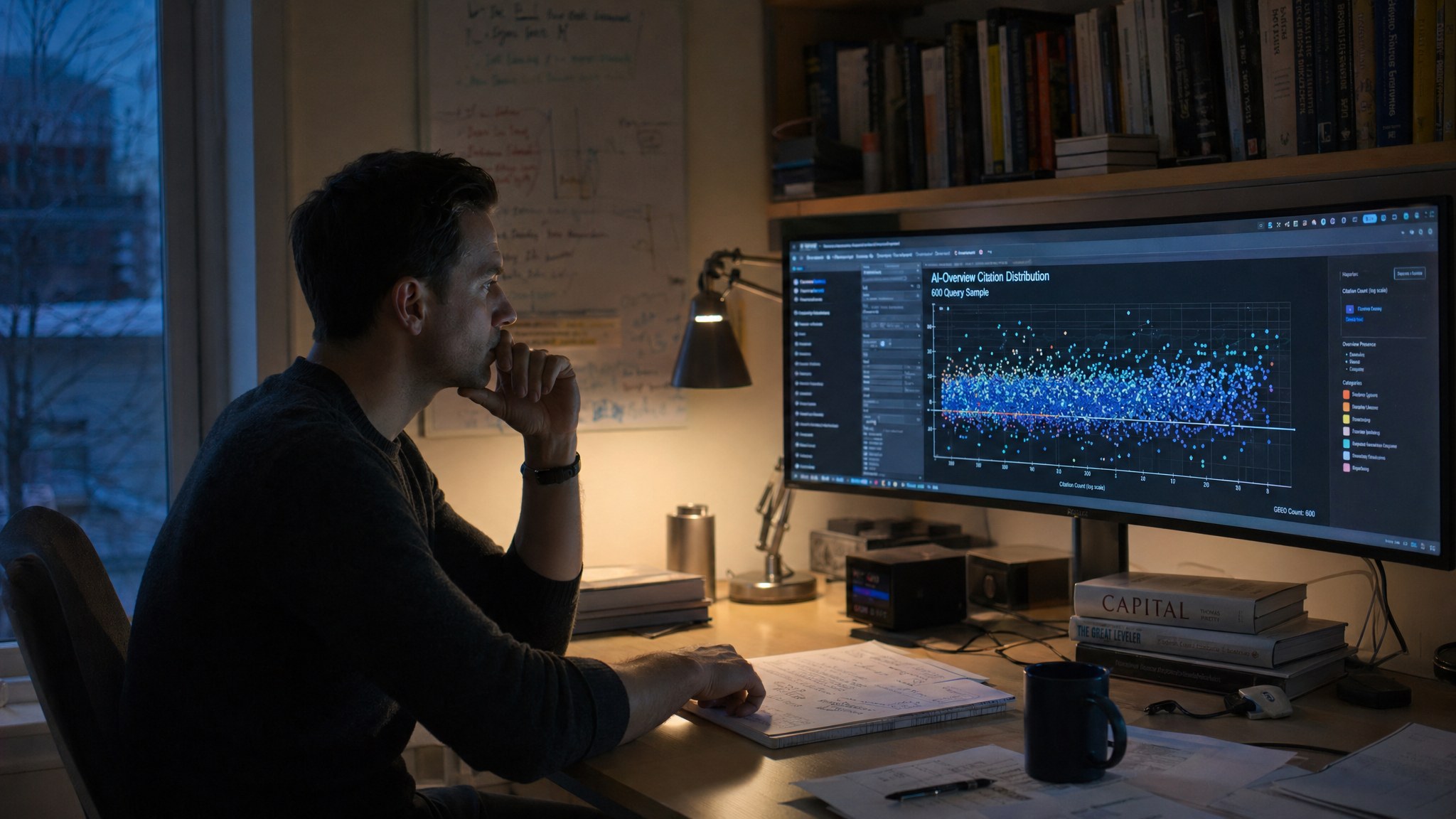
600 product queries. 12 categories. 4,184 individual citations logged. The dataset took our team three weeks to build in March 2026. The findings reset most of what brands assume about AI Overview visibility, including the assumption that domain authority is the primary driver. It isn’t. We’ll show you what is.
This is the methodology, the headline numbers, the surprises, and the actionable takeaways for any 7-9 figure ecommerce brand trying to win citation share before Q4.
Methodology: 600 queries, 12 categories, weighted scoring
We picked 12 categories where Amazon brands compete: pet food, supplements, outdoor gear, kitchen tools, grooming, baby, fitness equipment, beauty, pantry, sleep, home cleaning, and tools. For each category we built a 50-query basket: 20 head terms, 15 problem queries, 15 comparison queries. Same buyer-journey split we’ve documented in our audit playbook.
Each query was run from a US IP in incognito between March 4-22, 2026. We logged the AI Overview citation list for every query that triggered an Overview, 87% of head terms, 72% of problem queries, 64% of comparison queries. We did not log queries that returned no Overview. Final dataset: 4,184 citations across 12 categories.
Citations were weighted by position (3-2-1 for positions 1-2-3+) and aggregated by domain. We then cross-referenced each cited domain against three external metrics: Ahrefs Domain Rating, monthly branded organic search volume, and our internal mention velocity score (mentions per month across the open web, weighted by source authority).
Headline finding: concentration is severe
The top 3 cited domains in any single category captured a median of 47% of all weighted citations in that category. The top 10 captured 78%. Below the top 10, the citation distribution flattens into long-tail noise, domains cited once or twice that may or may not be cited again next quarter.
The implication: the addressable citation set per category is small. If you can rank in the top 10 cited domains for your category, you have a defensible position. The top 3 is the prize. Everything below the top 10 is a coin flip.
Concentration varied by category. Pet food was the most concentrated, top 3 captured 61% of citations, dominated by Wirecutter, The Spruce Pets, and Dogster. Tools was the least concentrated, top 3 captured 34%, with citations spread across YouTube creators, Reddit threads, and a dozen niche review sites. Higher concentration means harder to break in but more defensible once you’re in. Lower concentration means easier entry but lower share.
The metric that predicted citation share, and the one that didn’t
We ran correlations across all 4,184 citations. The single strongest predictor of weighted citation share was branded mention velocity, how often a domain is mentioned across the open web per month, weighted by the authority of the mentioning source. Correlation: 0.74. Strong.
The weakest predictor was Ahrefs Domain Rating. Correlation: 0.31. We had assumed DR would be a strong proxy. It isn’t. Several domains with DR under 50 outperformed domains with DR over 80 in citation share within the same category. The Google AI model is not picking citations by raw authority. It’s picking by how often the entity appears in fresh, contextually-relevant content across the web.
Branded organic search volume was a moderate predictor, correlation 0.52. Useful but not decisive. Worth tracking but not worth optimizing toward as a primary KPI.
The actionable read: if you’re trying to get cited, building branded mention velocity is more efficient than chasing high-DR backlinks. A weekly cadence of cite-worthy editorial pieces, distributed to category-relevant publications, will move citation share faster than 50 directory backlinks or guest posts on irrelevant high-DR sites.
The surprises
Reddit is in the top 5 in 8 of 12 categories. Google AI Overviews aggressively cite Reddit threads as sources. We expected this in some niches. We did not expect it in 8 of 12. The brands that monitor and (where appropriate) participate in their category’s subreddit are gaining citation share. The brands that ignore Reddit are leaving citation surface area on the table. Note that Amazon listings themselves get almost zero AI Overview citations, we covered why here.
YouTube creators are cited more than expected in physical-product categories. Tools, fitness, outdoor, YouTube creators with 50K-500K subscribers cited at higher rates than mid-tier publications. The model preferentially cites video content with structured transcripts and clear product mentions.
Brand-owned content rarely gets cited. Of 4,184 citations, only 217 were from brand-owned domains (~5%). The model heavily preferences third-party sources. The implication: investing only in your own blog will not get you cited at scale. You have to win third-party coverage.
Citation freshness matters. 68% of citations were from content published or substantively updated within the last 12 months. Older evergreen content gets cited but at decaying rates. Republishing and updating high-performing content quarterly is a real lever.
What to do with this data
One: run our 30-query audit (or a 50-query version) on your category. Identify the top 10 cited domains. That’s your pitch list.
Two: stop optimizing for DR-driven backlinks. Optimize for mention velocity. Ship original-data editorial content monthly. Pitch the top 10. Get covered.
Three: build a Reddit and YouTube creator strategy. Not for direct sales, for citation surface area. Even one strong Reddit thread or one YouTube review in a high-cite creator’s catalog can compound citation share for 12+ months.
Four: refresh existing top-performing content quarterly. Citation freshness decays. Update your strongest pieces with 2026 data and dates and re-pitch them.
If you want the full 12-category dataset and our internal mention velocity scoring methodology, we share it with brands engaging us for a Google footprint audit. Email Jason or reply to this post to get on the list.
Related Reading