

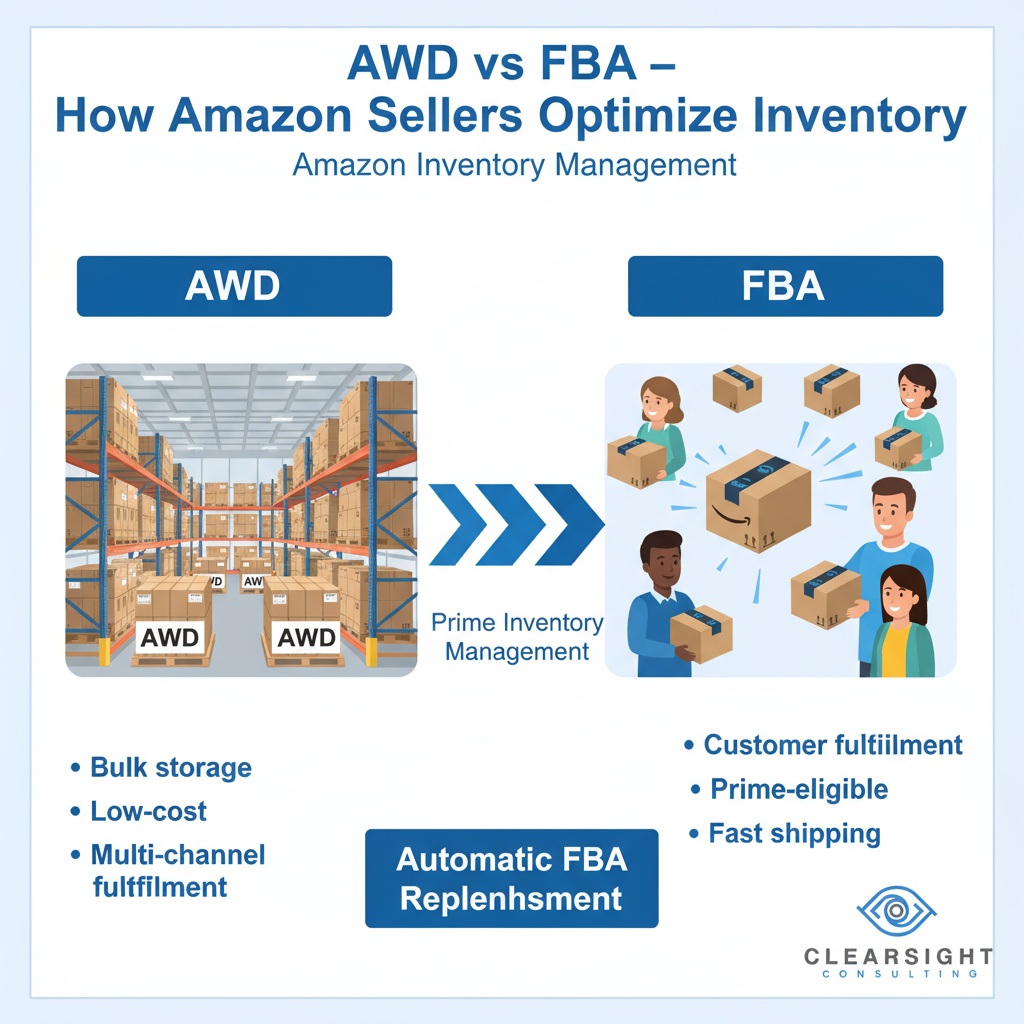
As an Amazon seller, understanding the difference between FBA (Fulfillment by Amazon) and AWD (Amazon Warehousing & Distribution) is crucial for maximizing profits, reducing costs, and maintaining Prime eligibility. In this article, we break down the key differences, explain how these programs work together, and show you how to use them to your advantage during high-volume sales periods like Black Friday.
What is FBA (Fulfillment by Amazon)?
FBA is Amazon’s program where sellers send their products to Amazon fulfillment centers, and Amazon handles storage, shipping, customer service, and returns. This is ideal for sellers looking to reach a wide audience quickly and offer Prime-eligible products to boost conversions.
Benefits of FBA
- Prime-eligible listings for higher conversion rates
- Amazon handles delivery and customer support
- Eligible for advertising and promotions on Amazon
Costs Associated with FBA
- Fulfillment fees per unit shipped
- Storage fees, especially high during Q4
- Long-term storage fees for inventory sitting too long
In short, FBA is your customer-facing inventory, the stock that Amazon ships directly to buyers.
What is AWD (Amazon Warehousing & Distribution)?
AWD acts as a 3PL (third-party logistics) solution inside Amazon’s ecosystem. It’s primarily used for bulk storage, staging, and inventory replenishment rather than direct customer fulfillment.
Benefits of AWD
- Lower storage fees compared to FBA
- Store pallets or cases for long-term inventory
- Automatically replenish FBA inventory to prevent stockouts
- Option to ship inventory to other channels like Shopify or Walmart
AWD is your back-end warehouse where bulk inventory is staged before being sent into FBA or other sales channels.
How FBA and AWD Work Together
The most effective setup for Amazon sellers is a two-tier inventory strategy:
- Store bulk pallets or cases in AWD for low-cost storage.
- Allow Amazon to automatically replenish FBA as sell-through occurs.
- Maintain Prime availability without overstocking FBA, especially during high-demand periods like Black Friday and Cyber Monday.
AWD vs FBA: Quick Comparison
| Feature | FBA | AWD |
|---|---|---|
| Purpose | Customer fulfillment | Bulk storage & replenishment |
| Audience | Amazon customers | Amazon + other sales channels |
| Inventory type | Individual units | Cases or pallets |
| Cost | Higher (fulfillment + storage) | Lower (storage only) |
| Prime-eligible | Yes | No |
| Auto replenishes FBA | Yes | Yes |
| Multi-channel fulfillment | No | Yes |
Conclusion
For Amazon sellers, combining AWD and FBA is a smart strategy to reduce costs, prevent stockouts, and maintain Prime eligibility. AWD stores bulk inventory efficiently, while FBA ensures your products reach customers quickly and reliably. By using both, you can optimize your Amazon operations year-round, especially during high-volume periods like Black Friday and Cyber Monday.
Want to learn more about maximizing your Amazon sales with AWD and FBA? Contact ClearSight Consulting today and let our team help you build a winning inventory strategy.