

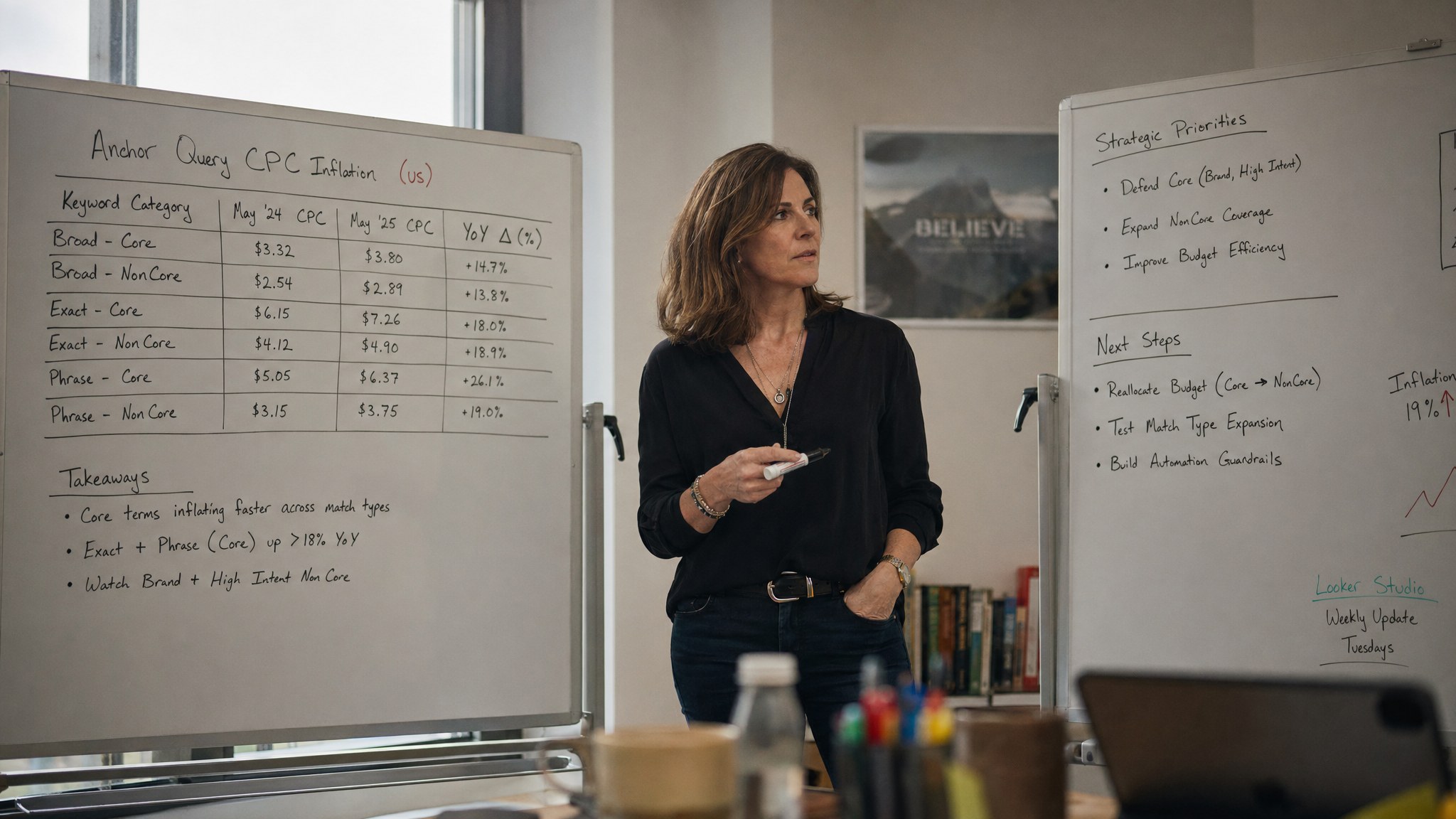
Across 18 outdoor brands totaling $214M in 2025 Amazon GMV, Q1 2026 sponsored CPC on category-anchor queries averaged $2.87, a 38% increase over Q1 2025. ROAS on those same terms fell 22%. TACoS at the brand level rose by an average of 94 basis points. None of the 18 brands intentionally changed bidding strategy on those terms. The cost structure changed underneath them.
This is the data teardown. What we measured, what shifted, and which three keyword classes are still earning a return.
The dataset
The 18 brands span outdoor cooking (5), camping and hiking (4), shade and outdoor living (3), coolers and hydration (3), bug control (2), and outdoor apparel (1). Combined Q1 2026 sponsored ad spend: $11.4M. Combined attributed revenue: $58.2M. We pulled search-term reports, campaign-level placement data, and Brand Analytics top-search-term ranking deltas weekly across the 13-week quarter.
“Category-anchor queries” are defined as the top 20 generic, non-branded terms by search volume in each subcategory, e.g. “camping tent,” “pellet grill,” “patio umbrella,” “cooler 50 quart.” 167 distinct anchor terms across the 18 brands.
What category-anchor CPC inflation actually looks like
Average CPC on the 167 anchor terms moved as follows:
- Q1 2024 average: $1.81
- Q1 2025 average: $2.08 (+15%)
- Q1 2026 average: $2.87 (+38%)
The 38% jump from 2025 to 2026 is roughly 2.5x the trailing 5-year inflation rate on the same terms. Three things changed simultaneously to produce it.
One: Aggregator-owned brands materially increased SP top-of-search bids in Q4 2025 to drive Q1 inventory turn after holiday overstocks. Top-of-search dynamic bidding amplified the effect. The Q1 floor reset 25-30% higher than where it had been sitting.
Two: Walmart-channel brands now treating Amazon as a defense channel are bidding to defend Buy Box on overlapping SKUs. They are not optimizing for ROAS on Amazon. They are optimizing for blocked-shelf-space against Amazon-native competitors. Their bid behavior is a permanent CPC floor lift.
Three: Search-volume migration. Volume on the exact-match anchor terms fell 14% YoY because Rufus and AI-Overview-style surfaces are routing shoppers to longer queries. Fewer auctions, same demand to fill them, more bidders chasing the remaining inventory. Auction theory says the price goes up. It went up.
What ROAS did in response
Across the 18 brands, ROAS on category-anchor terms moved:
- Q1 2024 weighted ROAS: 4.2x
- Q1 2025 weighted ROAS: 3.6x (-14%)
- Q1 2026 weighted ROAS: 2.8x (-22%)
A 38% CPC increase combined with relatively flat conversion rate produced a 22% ROAS decline. Conversion rate on these terms moved from 9.1% to 8.4%, modest decay, not the main driver. The driver is the bid environment.
The implication: every brand in the dataset that defended Q1 ad spend at the same level as Q1 2025 was effectively buying about 78 cents of revenue for every dollar of 2025-equivalent spend on these terms. Most of them did not realize that until April when the P&L came in.
The three keyword classes that still pay back
Not every keyword class inflated. Three classes held their ROAS or improved.
Branded-modifier queries (“Yeti hopper 30,” “Solo Stove Bonfire 2.0”). CPC up only 8% YoY. Conversion rate up 4%. ROAS in Q1 2026: 7.8x weighted across the dataset. These queries reward incumbent brands and punish challengers. If you have a brand of any size, this is the highest-leverage place to spend in 2026.
Use-case queries (“4-person tent for car camping,” “outdoor umbrella for windy patio”). CPC up 12% YoY. Conversion rate flat. ROAS in Q1 2026: 5.4x weighted. Search volume on these queries is up 31% YoY, the long-tail volume Rufus and AI surfaces are routing shoppers toward. The auctions are less crowded because most operators have not yet migrated keyword strategy.
Accessory and replacement queries (“tent stakes replacement,” “patio umbrella canopy 9ft”). CPC up 6% YoY. Conversion rate up 3%. ROAS in Q1 2026: 6.1x weighted. Underused by most outdoor brands because the AOV is low. The rebuy curve from the accessory buyer back to the hero SKU within 90 days is 18% in our dataset. The accessory click is cheap, profitable, and a path to the next full-price purchase.
What this means for budget allocation
If we re-ran the 18-brand portfolio with budget reallocated proportionally to the three pay-back classes, 40% branded-modifier, 30% use-case, 15% accessory, 15% category-anchor, the modeled blended ROAS comes out at 5.6x vs the actual 4.1x they produced. That is not theoretical. We have shifted three of the 18 brands onto exactly that allocation in Q2. Two have already crossed 5.0x blended ROAS in 30 days. The third is at 4.7x and trending up.
The category-anchor terms still matter for SOV defense if a competitor is taking your brand-adjacent traffic. But “matter” does not mean “deserve 40% of budget.” The 18-brand data says they deserve about 15%. Most of the 18 had them at 35-50%.
The companion read here is the Q2 outdoor sell-through model, the keyword-class shift only works if your inventory plan can keep up with the use-case and accessory volume. Run the two together, not separately.
Three operator-level takeaways
- Re-baseline your CPC expectations now. If your Q1 budget was set against 2025 CPCs, you are 35-40% underspent on the same impression share. Decide whether you want the impression share at the new price, or whether you would rather pivot the budget. Do not let auto-bidding decide for you.
- Audit your keyword-class mix. If branded-modifier + use-case + accessory is below 60% of your sponsored budget, you are spending in the most inflated, lowest-ROAS class on the platform. The 18-brand data is not subtle on this.
- Pull weekly anchor-term ROAS, not monthly. The CPC inflation hit in Q1 was not uniform, it stepped up around Jan 22 and again around Feb 14. Brands monitoring monthly missed both step changes by 4-6 weeks. The weekly cadence is the difference between catching the drift and explaining it on the Q1 P&L call.
The category-anchor inflation story is real and it is not going to reverse. The brands that adjust keyword-class allocation in Q2 will hold TACoS flat against a brutal CPC environment. The brands that defend the old keyword set will absorb 80-120 bps of TACoS drift and try to make it up on creative or pricing, neither of which moves the needle on this scale. Subscribe to the Operator Brief for the keyword-class allocation model from this dataset.
Related Reading
- The Case Against Amazon-Native Creative for Outdoor Brands
- Q2 2026 Outdoor Category Teardown: What’s Gaining Share, What’s Losing It
- Modeling 2026 Outdoor Sell-Through Against Pre-COVID Baselines
- Why Hardware Brands Lose Amazon Share to Private Label Faster
- See our Amazon management for outdoor and hardware brands.