

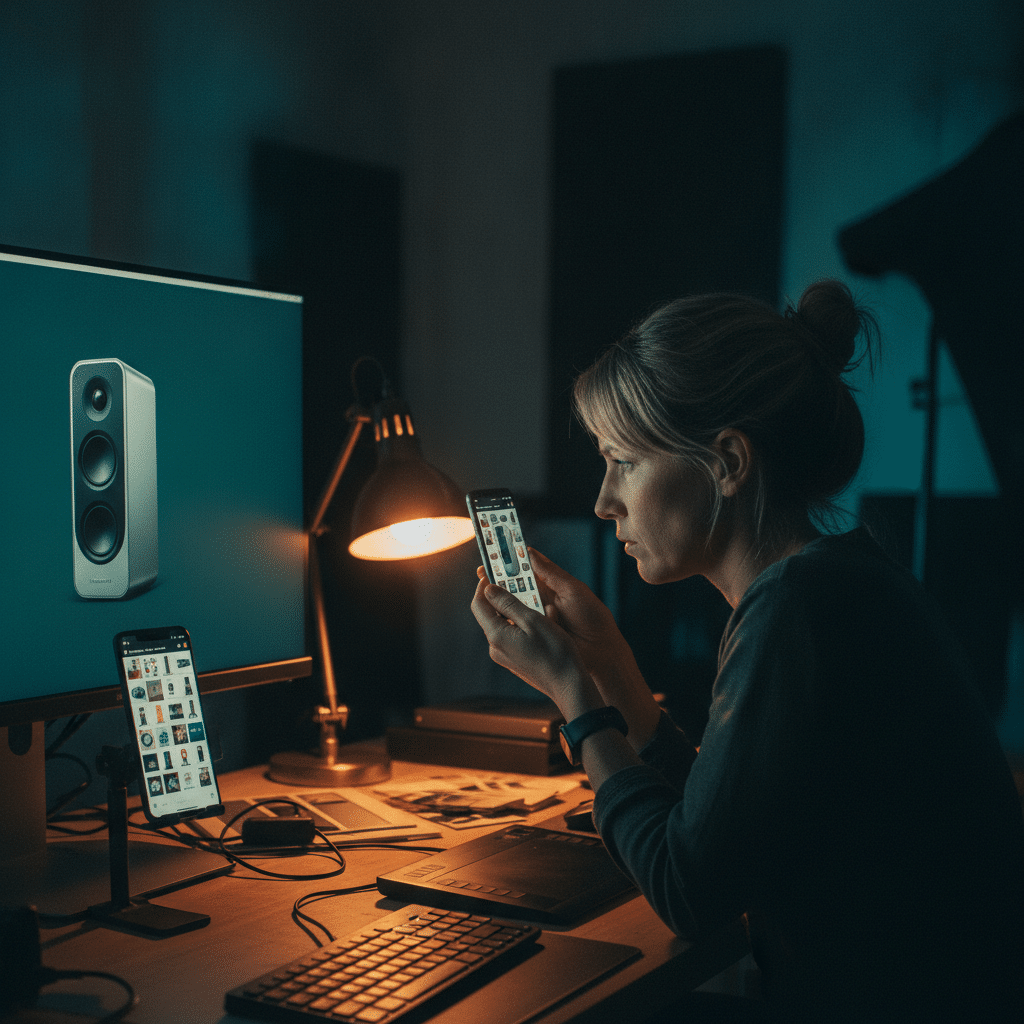
Open your best-selling listing on your phone. Look at the main image in search results, not on the product page. That thumbnail is roughly 186 pixels wide, and it is where 70% of your shoppers meet your product first. If the hero does not read at that size, the rest of your listing never gets a vote.
That is the whole case for the Amazon hero image mobile first rule. Design the main image for the smallest screen it will ever appear on, then let desktop inherit the win. Most brands do the reverse, they approve a beautiful hero at full desktop scale and never check it at thumbnail. It looks finished in the design file and disappears in the search grid.
The 60% rule, stated plainly
On every new client, we hit one rule before we touch anything else: the product has to occupy and resolve in the top 60% of the image frame. Not the full frame, the top 60%. On a mobile search result, the bottom of the thumbnail is cropped, crowded by the price, the Prime badge, and the star rating. Anything you put in the bottom 40% is decoration the shopper’s thumb is already scrolling past.
An Amazon hero image mobile first means the hero subject, the product, filling the frame, unmistakable, lives where the eye lands and the crop cannot kill it. The brand’s job is identification in under a second. Scale contrast does that. A product shot at 70% of canvas reads; the same product at 35% of canvas, floating in white space, does not.
What breaks at 186 pixels
The Amazon hero image mobile first test is brutal at this size. Three things die at thumbnail scale, every time.
Tiny text. If your hero has a callout in 14-point type, it is sub-pixel mush on mobile. Amazon bans most text on the main image anyway, but brands sneak it onto packaging-in-frame. At 186 pixels it is noise, not information.
Thin products shot small. A slim bottle or a cable shot at full distance becomes a vertical sliver. Crop in. Fill the frame. A hero is not a catalog photo with breathing room, it is a billboard at the size of a postage stamp.
Multi-product clutter. A bundle of six items at thumbnail scale is six unreadable specks. Pick the hero unit, show it large, and let the bundle live in the secondary images where the shopper has already committed to looking.
How to test it in ten seconds
You do not need a usability lab. Take your hero image, shrink it to 186 pixels wide on your monitor, and step back four feet. That is the Amazon hero image mobile first check, and it costs you ten seconds. If you can name the product and the category from there, it passes. If you have to lean in, it fails, and you are losing the click before the listing copy ever loads.
This is the same discipline that governs the mobile rebuild on A+ content: the decisive information lives in the top 60% of the module, because the bottom is below the fold on the device most shoppers actually use. The hero is just the first and most expensive version of that rule.
What to do Monday
Pull your top five SKUs and look at each hero on a phone, in search, not on the product page. Ask three questions. Does the product fill the top 60%? Can you identify it at thumbnail scale? Is there anything in the bottom 40% you are counting on the shopper to see?
If the answer to that last one is yes, you have already lost it. Rebuild the hero so an Amazon hero image mobile first standard holds, product large, top 60%, legible at 186 pixels, before you spend a dollar driving traffic to it. The prettiest hero in the world loses to a clear one at the size that actually decides the click. Get the hero right and your Sponsored Brands creative has something worth clicking through to.
Written by the ClearSight Graphics & Design Team.
Related reading: