

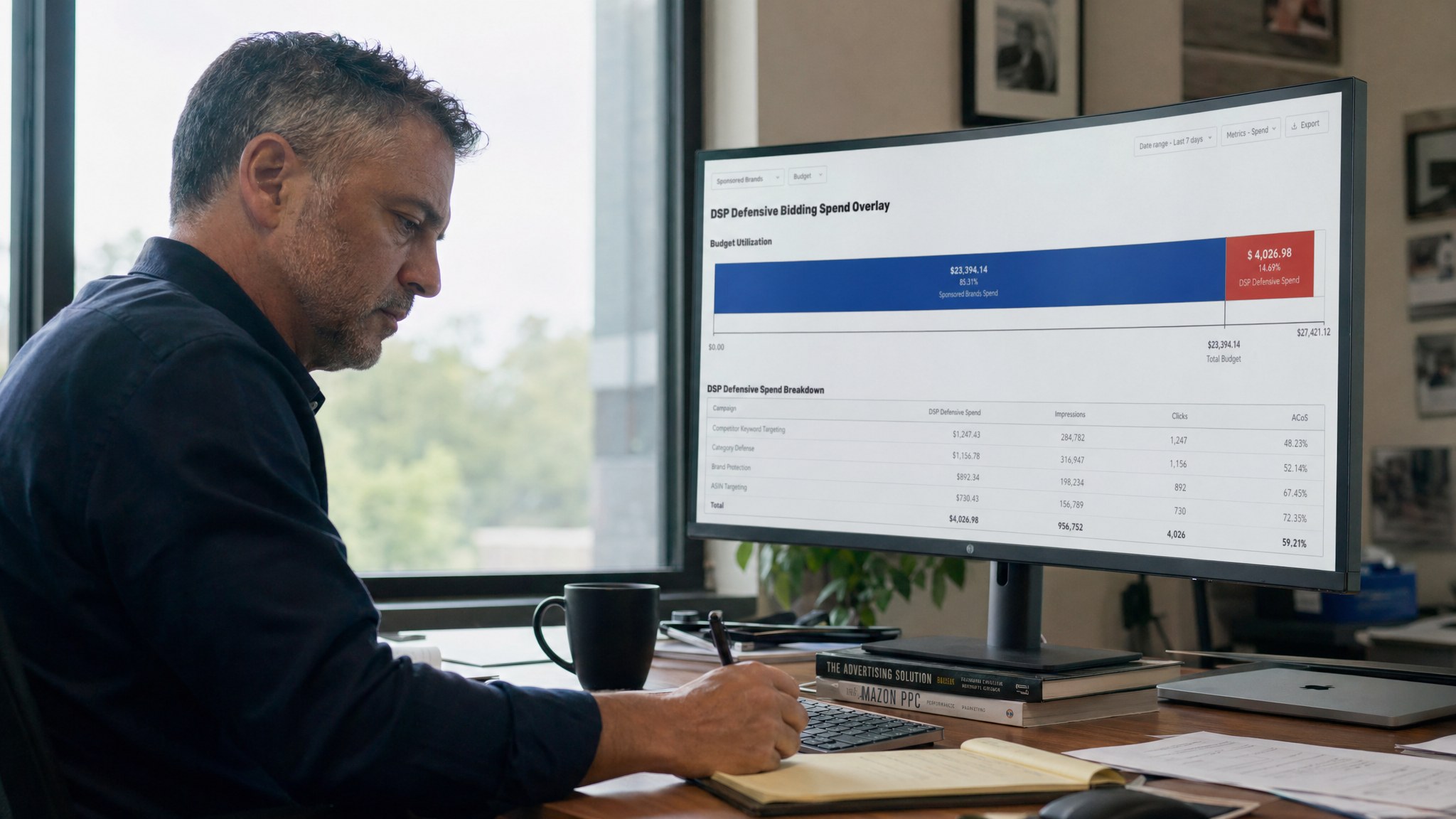
$0.84, that’s the average DSP CPM we saw last quarter for branded-keyword defensive line items across 22 mid-market accounts.
$3.40, the average Sponsored Brands CPC those same accounts paid to defend the same query at the same time.
Same shopper. Same intent. Same brand-defense outcome. Four-times the unit cost on Sponsored Brands. Yet 19 of those 22 accounts treated DSP defensive and SB defensive as separate budget conversations, owned by separate leads, with separate quarterly reviews.
The budget silo is the problem, not the tactic
Sponsored Brands is search-intent. DSP is audience-intent. The textbooks treat them as different beasts. In practice, when a competitor bids on your branded query, you have two ways to defend the SERP, pay SB at a $3-5 CPC, or run DSP audiences against shoppers who searched your brand in the last 30 days at a $0.50-1.20 CPM.
Most agencies route these to separate teams. SB lives under the search team. DSP lives under the programmatic team. They report to different P&Ls. Their quarterly budgets are negotiated independently.
The result: brands overspend on SB defensive at premium CPCs while their DSP defensive line item is underfunded by 60-80% relative to the audience overlap. We have not seen a single account in two years where the budget allocation between SB and DSP defensive matched the unit-economics opportunity.
When DSP defensive beats SB defensive on the math
DSP wins on three vectors when the goal is brand defense.
Cost per impression is 70-85% lower for the same eyeball. A shopper who searched your brand last week and is now browsing a competitor’s listing can be served a DSP brand-protection creative for under $1 CPM. SB on that same competitor’s listing costs $3-6 CPC and only fires when the shopper re-searches.
Reach is broader. SB defends the search query in the moment. DSP defends the shopper across the next 14-30 days, on detail pages, in display inventory, on Twitch, on Fire TV. If a competitor is running a flanker SKU campaign, SB catches the second search. DSP catches the comparison shop.
Frequency control is sharper. SB shows once per query. DSP can be capped at 3-5 impressions across the consideration window with audience exclusions for already-converted shoppers. Cleaner targeting, less wasted spend.
The conversation to have with your media lead this month
Stop reviewing SB and DSP defensive budgets in separate meetings. Run one meeting, one P&L, one owner.
The agenda is three numbers. SB defensive spend last quarter, DSP defensive spend last quarter, total branded-search query volume on Amazon for your top 10 ASINs.
If your DSP defensive spend is less than 25% of your SB defensive spend, you are leaving money on the table. The cheaper-CPM channel is being starved by org-chart accident.
If your DSP defensive line item does not exist at all, and roughly half of mid-market accounts we audit have zero DSP defensive even when they spend $30k+/month on SB defensive, you are buying brand protection at 4x retail.
For brands evaluating whether DSP belongs in the mix at all, our breakdown of Amazon DSP for the brand that’s outgrown Sponsored Brands covers the threshold conditions. The short version: if your branded search volume is north of 50,000 monthly queries and your competitors are bidding on it, DSP defensive pays for itself within 6 weeks.
What “right-sized” looks like
The accounts we work with that have reconciled SB and DSP defensive into one budget conversation typically land at a 60/40 or 55/45 split, SB heavier, but not 90/10 like the unreconciled default.
The 60/40 split looks expensive on the SB line until you remember SB defensive ROAS reports inflated by branded-search bias. SB defensive almost always reports 8-12x ROAS because the shoppers were going to buy anyway. DSP defensive reports a more honest 3-5x and does the actual interception work that SB cannot.
The reframe for your finance partner: SB defensive is a tax on brand awareness you already paid for. DSP defensive is the cheaper insurance on the same risk. Run them as one budget. Review them in one meeting. Hire one owner.
The brands that have been doing this for two years are the ones quietly compounding share while their competitors keep treating display and search as different sports.
Want us to model your SB-DSP defensive split on real data? Send us your last 90 days of campaign exports and we’ll return a side-by-side within 5 business days.
Related Reading
- DSP Creative Testing in 2026, The 5-Creative Rotation That Beats Algorithmic Optimization
- DSP Frequency Capping, What 40 Mid-Market Accounts’ Data Shows
- DSP Retargeting, Incremental Lift vs Reported ROAS Across 80 Audits
- Amazon DSP 2026, Audience Targeting Changes and Lookalike Economics
- See our paid media management and Amazon services.