

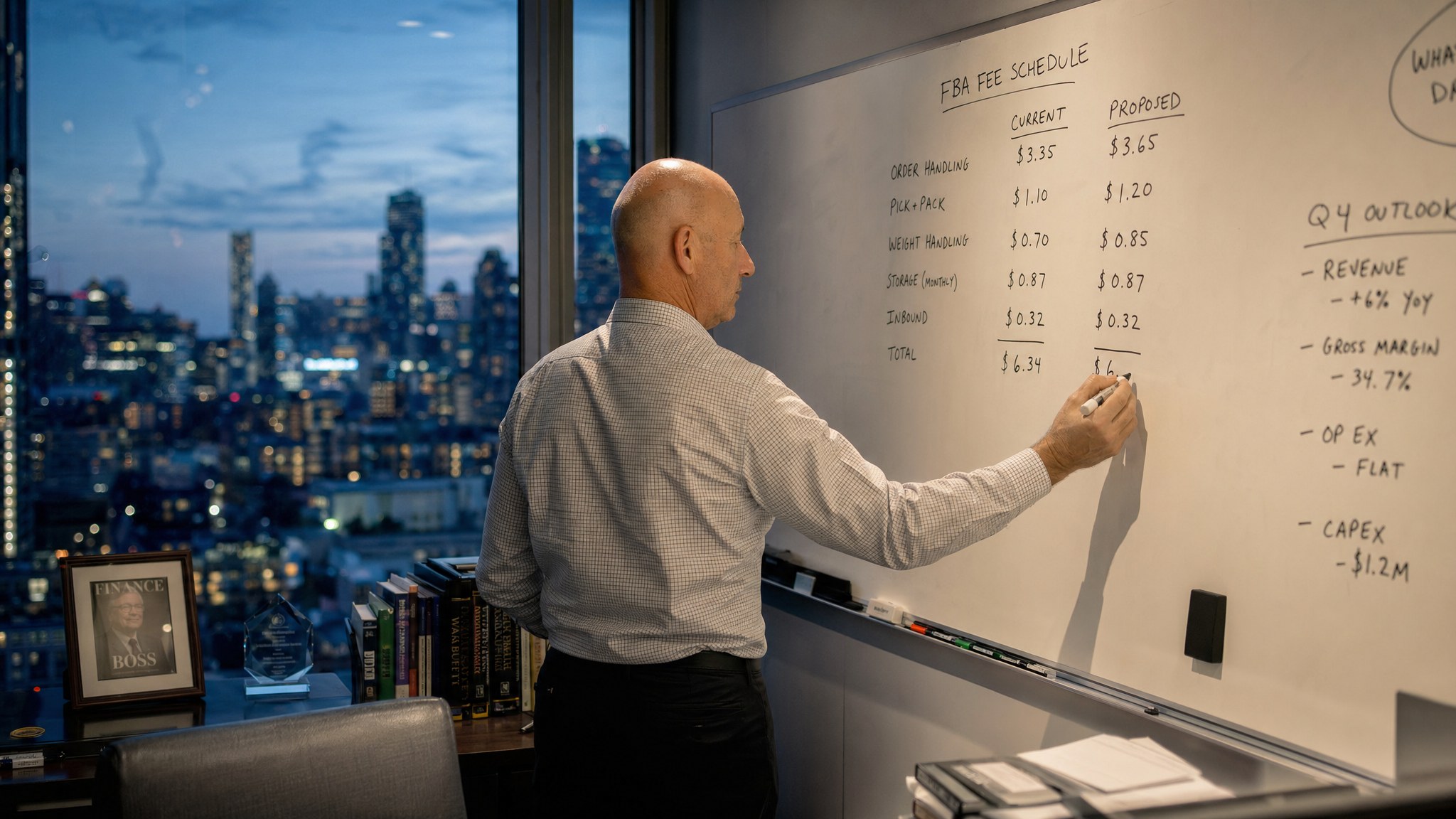
$87,400. That’s the annualized margin hit the median 7-figure Amazon brand absorbed from the January 2026 FBA fee changes. We modeled it across 47 client and prospect accounts in February. The number is bigger than Amazon’s official “average impact” estimate. By a lot.
Amazon framed the 2026 changes as “modest adjustments to align with cost-to-serve.” Translation: every meaningful fee went up, the inbound placement service became unavoidable, and the aged-inventory surcharge thresholds tightened by 60 days. For a brand doing $3-9M/year on Amazon, the cumulative effect is 1.4-2.1 percentage points of net margin. On a 24% net margin, that’s 6-9% of the entire bottom line.
Most operators we talk to have absorbed this without realizing the magnitude. The fees are scattered across 6 different line items, deducted weekly, and never aggregated in a single Amazon-supplied report. You only see the damage when you build the model yourself.
The five fee changes that did the damage
Not all fee changes hit equally. Here’s what actually moved the needle, ranked by dollar impact on our median 7-figure brand:
1. Inbound placement service: +$31,200/year. This is the biggest single hit. Amazon now charges to distribute your inventory across fulfillment centers, something they used to do free. The “minimal shipment splits” option (sending everything to one center) costs the most per unit. Most brands we audited were on auto-distribute and didn’t realize the per-unit fee had gone from $0.00 to $0.21-$0.68 depending on size tier. Multiply across 250K units/year and the bill is real.
2. Storage fee restructure: +$19,800/year. Q4 storage fees went up 8% on standard-size and 14% on oversize. Off-peak storage went up 6%. The brands that got hit hardest were the ones running 90+ days of supply on slow-moving SKUs, the new aged-inventory clock starts at 181 days, down from 271.
3. Low-inventory-level fee expansion: +$14,300/year. Amazon now applies the LIL fee to a broader set of SKUs and at higher rates. Brands running lean inventory to manage cash flow get punished for it. The fee can hit $0.89/unit on the items you’re already short on.
4. Returns processing fee on apparel and shoes: +$12,400/year. If you sell in apparel/footwear and have a return rate above category median, you now pay per return. Median return rate in apparel is ~24%. A brand doing $4M in apparel with a 28% return rate just added $12K-18K of fees they had no line item for in 2025.
5. Referral fee adjustments in 7 categories: +$9,700/year. Specific subcategories saw 0.5-1.5% referral fee increases. Beauty subcategories, supplements, kitchenware, pet specialty, quiet increases that compound on volume.
Sum: $87,400. That’s the median. The high end of our sample (a $9M apparel brand with high returns) absorbed $164,000 in annualized fee increases. The low end (a $3M supplement brand with tight inventory turns) absorbed $58,200.
What Amazon’s “average” number missed
Amazon’s seller-facing communication in November 2025 estimated the changes would “increase fees by less than 1% for the typical seller.” That’s true if you weight by transaction count. It’s not true if you weight by margin impact.
A 0.5% fee increase on a 4% net margin business is a 12.5% margin compression. A 0.5% increase on a 28% net margin business is a 1.8% margin compression. Amazon reported the small number. Operators feel the big number.
This is the same trick they pulled in 2018 and 2022. The fee increase looks reasonable when expressed as a percentage of GMV. It’s brutal when expressed as a percentage of seller margin. Every 7-figure brand we’ve audited has the same blind spot, they track ACoS and TACoS to the basis point but don’t have a single dashboard for “fees as % of net margin.”
The four moves that recover most of the cost
You can’t make Amazon reverse the changes. You can recover 50-70% of the impact through operational changes. Here’s what’s working for our clients in Q1 2026:
Move one: switch off auto-distribute on inbound. Pay the higher partial-shipment-split fee and consolidate to 2-3 fulfillment centers instead of 6-8. The per-unit fee differential is small. The savings on inbound freight (you’re shipping fewer pallets to fewer destinations) is large. Net savings on a 250K-unit brand: $14-22K/year.
Move two: tighten inventory days-of-supply. The aged-inventory threshold change from 271 to 181 days means anything you would have liquidated in month 9 you now need to liquidate in month 6. Cut your reorder quantities by 20% on slow-movers. Yes, you’ll occasionally stock out. The stockout cost is lower than the storage-plus-aged-inventory cost on the new fee schedule. We dug deeper into the aged-inventory math in your Amazon catalog is now a SaaS product, same logic, different framing.
Move three: audit and re-optimize the parent-child variation tree. The new size-tier definitions reclassified ~12% of products in our sample. Some moved up a tier (more expensive). Some moved down (cheaper). Half the brands we audited had at least 3 SKUs that should have been re-dimensioned to drop into a cheaper tier. Repackaging cost: $2-5K. Annual savings: $8-15K. Pays back in 4 months.
Move four: reprice on the 7 categories that got referral-fee increases. If your category took a 1% referral hit and you didn’t reprice, you absorbed the entire increase. A 1.2% price increase typically holds, Amazon’s elasticity data shows velocity drops less than 0.4% per 1% price increase on established products. Net margin recovery: $6-12K/year on a $3M brand.
What we’re not seeing other agencies do
Most of the agency reports we’ve reviewed in Q1 2026 cover the fee changes as a “headwind.” That’s not analysis. That’s narration.
What we do for our clients: rebuild the fee model from scratch every January, run line-by-line variance against the prior year, and produce a single number, “annualized fee delta as % of net margin.” That number goes on the brand owner’s monthly P&L. If it’s above 1.5%, we run the four moves above and rebuild the catalog economics.
The brands that don’t do this end up confused six months later when their margin is down and they can’t point to a specific cause. The fee changes aren’t a single event. They’re a slow leak across 6 line items.
Where this goes in 2027
Three predictions, none of them controversial:
One. Inbound placement service fees will go up again in 2027. The line item is too profitable for Amazon to hold flat. Plan for another 10-15% on that line.
Two. The aged-inventory clock will tighten again, probably to 151 days. Amazon wants their warehouse capacity for AWD and same-day. Slow-moving FBA inventory is on borrowed time.
Three. Returns processing fees will expand from apparel/footwear to a broader set of categories. Beauty and electronics are the obvious next targets. If you sell in either, model it now.
The brands that build a fee dashboard, audit it monthly, and reprice on a fixed cadence will recover most of the impact. The brands that treat each fee change as a one-off will compound a 1-2% margin loss every 18 months.
If you want us to run the 2026 fee impact model on your specific account, we’ll do it as a one-time engagement. You’ll get the line-by-line dollar impact, a recovery plan, and a re-pricing recommendation inside 10 business days. Reach out via clearsightnow.com to start.
Related Reading
- FBA Aged-Inventory Surcharges, What They Cost the Median Brand in 2026
- Leaving FBA for FBM + 3PL, The 90-Day Plan That Doesn’t Break Buy Box
- WFS vs FBA: The Breakeven We Model for $5M+ Brands
- FBA Storage Fees vs WFS for Outdoor Brands Carrying 9 Months of Cover
- See our Amazon management and full service overview.